Goats on a Wall

What is acceptable risk?

Philosophy

Sunday, September 25, 2016

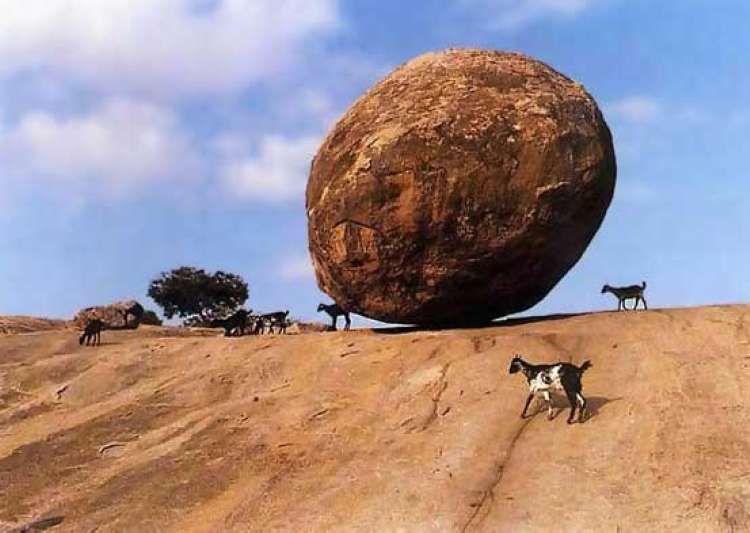
Balancing Rock, Tamil Nadu

top 5 natural wonders in india- India Tv 

 
Balancing Rock is 60 km from Chennai in Mahabalipuram. Often referred to as Krishna's Butter Ball, it is a huge boulder resting on a narrow rock base.

The rock is so precariously perched on a small surface area that as one TripAdvisor travellers says, "You almost don't want to stand in front of it." This is an excellent place for all the shutterbugs.

 krishnas-butterball-10
 A massive stone, popularly known as the Krishna's Butter Ball, has balanced itself precariously at the slippery edge of a hill for ages. Looking at it, one wonders as to how come a 20-feet-high, 5-metre-wide and 250-ton stone stood the test of time to remain stuck at that place for so many years. Apart from attracting travellers, the rock also serves as a shade for animals who want to stay away from the sun for a while.

Balancing Rock at Mahabalipuram

Located in the Mahabalipuram town of Tamil Nadu, the balancing rock is originally known as Krishna's Butterball which is serves as a one of the major centre of tourist attractions in the town.
The “butterball” is actually a giant balancing rock which is 5 meters in diameter, is perched on a smooth slope, seemingly defying all laws of physics.

There is a round rocky huge ball that is miraculously balanced in place at an angle of 45 degrees.


Posted by Robert Lewis and Jennifer Hodson at 5:12 PM No comments:
Email ThisBlogThis!Share to XShare to FacebookShare to Pinterest

Wednesday, September 14, 2016

Goats with a tale to tell


Wildlife
Country diary

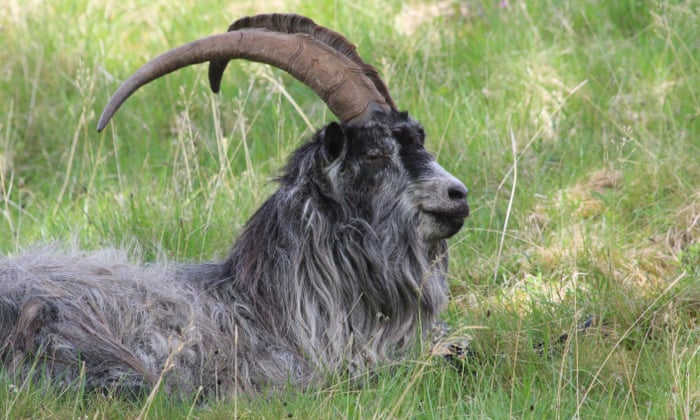
Four billy goats with a tale to tell


Coignafearn, Highlands There is something about wild goats that appeals to me – perhaps their look of superiority?

 
A wild billy goat sitting down in the shade of a birch. Photograph: Ray Collier 
Ray Collier

Saturday 25 June 2016 05.30 BST Last modified on Saturday 25 June 2016 05.31 BST
Standing on the side of the burn, I watched the water flow past my feet, gurgling and murmuring as it continued on its way to the river Findhorn below. After the cold spring, the spring and early summer plants were all flowering together. The yellow carpets of bird’s foot-trefoil, or “eggs and bacon” as I prefer to call it, dominated the scene. On the drier areas were small groups of mountain pansies whose flowers varied from red to intense violet.

The butterworts in the splash zone of the burn were such an outstanding purple that their tiny flowers looked much larger than they actually were. Lady’s smock plants – also known as cuckooflowers, because they bloom when the first cuckoo begins calling – stood out above the others. Their slender stems topped with tiny pale lilac flower heads looked as if they were just waiting for an orange tip butterfly to lay its tiny orange eggs on them.


Eye to hypnotic eye with a one-horned nanny

Large tracts of junipers, blue-green in the strong sunshine, have spread up the hillsides, making them impenetrable in places. On the scalloped margins, browsing by red deer on the outer shoots has formed unusual shapes, like topiary. Junipers are among my favourite shrubs, although, as they stand up to two metres high, perhaps “trees” would be a better word. 

Coignafearn is a strath favoured by golden eagles and peregrines as a hunting area, but even with binoculars I could not spot any of these raptors. However, as I was scanning the open hillsides I did have a strong feeling that I was being watched. Eventually I spotted them. Four large, dark, wild billy goats, sitting down in the shade of a solitary birch tree, all panting in the heat.

There is something about wild goats that appeals to me – perhaps their look of superiority? All four billies had huge, gracefully curved horns, and I counted the annual growth rings on one. He was between eight and nine years old. What stories he could tell of his tribe in that strath. I nodded my head in respect and left.


Follow Country diary on Twitter: @gdncountrydiary

Topics
Wildlife
Summer
Rural affairs
Plants
Scotland

https://www.theguardian.com/environment/2016/jun/25/four-wild-billy-goats-highlands-scotland-country-diary#img-1


Posted by Robert Lewis and Jennifer Hodson at 8:51 PM No comments:
Email ThisBlogThis!Share to XShare to FacebookShare to Pinterest

Old Goats

Research Councils UK ‏@research_uk 6m6 minutes ago
.@thetimes: 'Rise of old-age loneliness is dismissed as just a myth' in @ESRC-funded study http://ow.ly/A9aP302lbdn 
 
Posted by Robert Lewis and Jennifer Hodson at 8:43 PM No comments:
Email ThisBlogThis!Share to XShare to FacebookShare to Pinterest

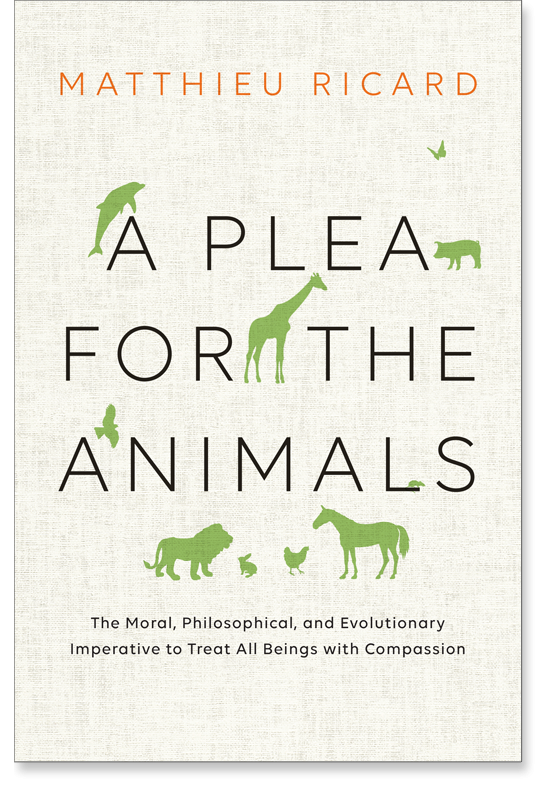
A Plea For The Animals

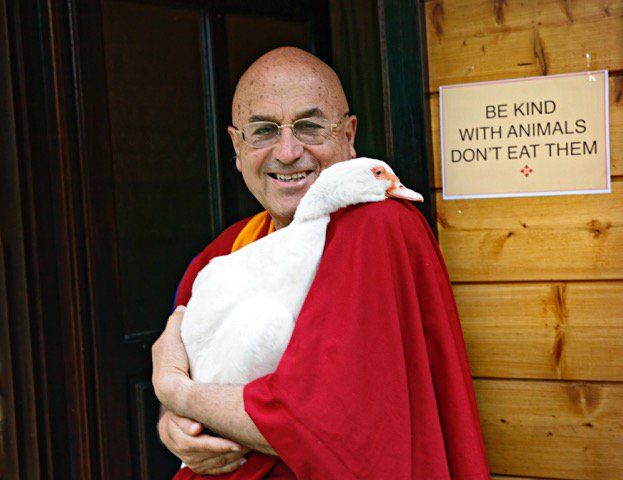
Matthieu Ricard ‏@matthieu_ricard Sep 13
“Kindness, altrustic love and compassion don't harmonize well with bias.”- #APleaForTheAnimals http://bit.ly/29og7CL 


A Plea for the Animals, a new book by Matthieu Ricard. Every animal just wants to be free. #APleafortheAnimals


Posted by Robert Lewis and Jennifer Hodson at 5:18 PM No comments:
Email ThisBlogThis!Share to XShare to FacebookShare to Pinterest

Monday, May 23, 2016

Goats Fighting

Goats Fighting
The Metropolitan Museum of Art


Heilbrunn Timeline of Art History

  • Essays
  • Works of Art
  • Chronology
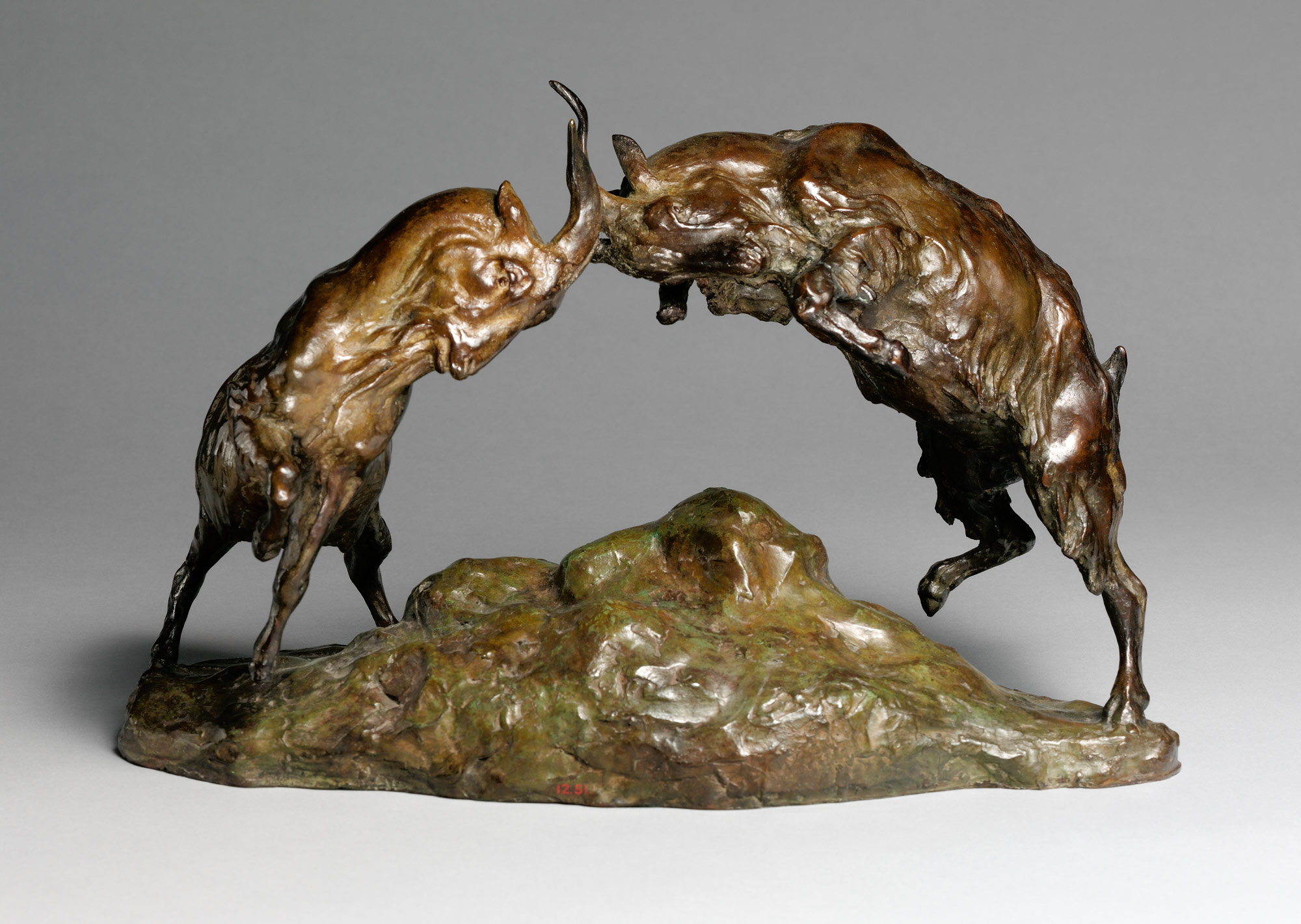
Goats Fighting

Goats Fighting

Artist: Anna Hyatt Huntington (American, Cambridge, Massachusetts 1876–1973 Redding, Connecticut)
Date: 1905, cast before 1912
Medium: Bronze
Dimensions: 10 1/4 x 14 5/16 x 7 1/2 in. (26 x 36.4 x 19.1 cm)
Classification: Sculpture
Credit Line: Rogers Fund, 1912
Accession Number: 12.51
For this group, also known as Goats Butting, Huntington sculpted two goats lunging together forcefully, their horns locking in combat. The rocky terrain on which they fight emphasizes the harshness of the conflict.

See additional object information
Link: http://www.metmuseum.org/art/collection/search/19222


  The Metropolitan Museum of Art

http://www.metmuseum.org/toah/works-of-art/12.51/
Posted by Robert Lewis and Jennifer Hodson at 2:24 AM No comments:
Email ThisBlogThis!Share to XShare to FacebookShare to Pinterest

Saturday, May 7, 2016

Pronghorn

  North America's fastest land animal can outrun a cheetah

Jaymi Heimbuch (@JaymiHeimbuch)
Science / Natural Sciences
July 10, 2013
 
pronghorn running photo
CC BY-ND-NC 1.0 Josh More

The pronghorn is one of the often overlooked mammals on the North American continent. Usually mislabeled as antelope, this species of grazer is actually more closely related to goats and vast herds once roamed throughout the plains.

At Carrizo Plain National Monument in California, a small herd of once-native pronghorn has been reintroduced.
 
Pronghorn are the fastest land animal on North America. In fact, it is the second fastest land animal in the world with only the cheetah clocking faster speeds.
The difference, though, is that while cheetahs can reach a faster top speed, they can only hold that speed for a few hundred yards. Pronghorn can sustain blazing speeds for miles, and in a distance run would easily beat a cheetah.

Pat Gaines /CC BY-NC 3.0
 Pronghorn can reach top speeds of around 55 mph and can run at a steady clip of 30 mph for over 20 miles. For comparison with the other fastest land animal, cheetahs can reach speeds of over 60 mph but only for sprints of about 700 yards.

Pronghorn could finish a marathon in about 45 minutes, while a human would be working hard to finish a marathon in over two hours.

This speed starts at a very young age. Females give birth in the spring to one or two fawns, which stay hidden in the grass until they are old enough to outrun their primary (non-human) predators of coyotes, bobcats and golden eagles. This happens in just a couple weeks. In fact, a fawn can outrun a human in just a matter of days after being born.

But if a pronghorn can so easily leave every predator on North America in the dust, even at a very young age, just how and why did it get to be this fast?

NWFblogs /CC BY-NC-ND 3.0
A Speed Machine
According to Stan Lindstedt, a comparative physiologist at Northern Arizona University, there is no secret trick to pronghorn reaching such incredible speeds. "It has simply perfected the same equipment that all mammals have," he told Discover Magazine.

"We found that pronghorn have an extraordinary capacity to process oxygen. Each antelope consumed between six and ten liters of oxygen a minute, which is five times as much as a typical mammal of similar size would burn--a 70-pound goat, say--and more than four times as much as Carl Lewis would consume if he were shrunk to the size of a pronghorn antelope. (A pronghorn stands about three feet at the shoulder.) Compared with the goat, it has bigger lungs with which to absorb oxygen, slightly more blood hemoglobin with which to transport the oxygen from the lungs to the muscles, and slightly bigger and leaner muscles containing a higher concentration of mitochondria--the cellular organelles that burn oxygen to provide power for muscle contraction. In other words, there are no tricks to the pronghorn antelope."
So why are they so amazing at running?

© Jaymi Heimbuch

Outrunning Ancient Predators
After 20-some years of wondering about pronghorn in his researches, Dr. Byers has come up with a compelling theory.

Though there is no predator today who can catch a pronghorn at a sprint, this wasn't always the case. Dr. Byers says the pronghorn runs this fast because it is chased by the "ghosts of predators past" -- including American cheetahs. This is why pronghorn can only be beaten by cheetahs in a sprint.

In American Pronghorn: Social Adaptations and the Ghosts of Predators Past, Dr. Byers argues that the pronghorn perfected its running prowess well over 10,000 years ago when the North American continent was still home to swift-footed predators like cheetahs, long-legged hyenas, the giant short-faced bear, huge jaguars and saber-toothed cats, along with the more familiar, albeit slower, coyotes and wolves.

Predators were much bigger and much faster back then, and thus forced the pronghorn -- and some similarly built and now extinct cousins -- to evolve to be incredibly fast. Though the predators disappeared, the pronghorns' ability to outrun them has persisted.

So now we have a marvel of speed still roaming the prairies, perhaps a relic but still fascinating.

Modern Threats
There are two things, however, that pronghorn cannot outrun, and these threats come from humans. The first is habitat loss from urban sprawl, and the second is miles upon miles of fencing along ranches, roadsides, farms and developments.

Habitat loss is a rather obvious threat. Pronghorn need vast spaces to forage for food. The less grassland they have, the less food they have, and the lower their chances for successful reproduction and survival. Not as obvious is the threat of fencing.

annikafae /CC BY-NC-SA 3.0

Pronghorn are amazing runners, but they cannot jump fences. We may think that because they look a little bit like deer, they can spring over a fence with the same lightness and nonchalance. But that is not the case, and miles of fencing put up along migration routes is a serious problem by limiting access to food and blocking off paths to get access to food, as well as room to outrun remaining predators.

As the National Parks Conservation Association states, "These 'new threats' not only restrict their greatest asset to escape predators but also their ability to migrate over long distances required to find adequate snow-free habitat and forage. As wildlife move from one place to another they do not distinguish between state, federal and private land; they go where there is habitat. Conserving pronghorn migration on public and private lands outside of the Yellowstone National Park offers the last best hope for this iconic species."

Fence removal programs have gone a long way in helping the pronghorn.

In 2010, the Yellowstone Field Office worked with landowners and the Gallatin National Forest to remove two miles of wooden fence and barbed wire, restoring the local pronghorns' migration route.

Similarly, in and around Carrizo Plain National Monument, miles upon miles of old barbed wire fencing remained in the area decades after the last human residents had moved away, creating a somewhat haphazard maze of barbed wire throughout the area. Volunteers continually help to remove or modify these fences to provide the newly reintroduced pronghorn room to escape coyotes and find forbs, like milkweed, which are their main food source.


 Link: http://www.treehugger.com/natural-sciences/nature-blows-mind-north-americas-fastest-land-animal-can-outrun-cheetah.html

 
 Tags: Animals | Conservation | Nature Blows My Mind


Pronghorn


Antilocapra americana 

  • Amphibians
  • Birds
  • Bugs
  • Fish
  • Invertebrates
  • Mammals
  • Prehistoric Animals
  • Reptiles

Map

Map: Pronghorns range Pronghorn Range

Fast Facts

Type:
Mammal
Diet:
Herbivore
Average life span in captivity:
11 years
Size:
Head and body, 3.25 to 5 ft (1 to 1.5 m), Tail, 3 to 4 in (7.5 to 10 cm)
Weight:
90 to 150 lbs (41 to 68 kg)
Group name:
Band or Herd
Did you know?
The pronghorn is the second fastest land mammal in the world, after the cheetah. It can attain speeds of over 53 miles (86 kilometers) per hour.
 
 
Photograph by
Stan Bysshe

Pronghorn


Antilocapra americana

Fleet-footed pronghorns are among the speediest animals in North America. They can run at more than 53 miles (86 kilometers) an hour, leaving pursuing coyotes and bobcats in the dust. Pronghorns are also great distance runners that can travel for miles at half that speed.

Pronghorns are about three feet (one meter) tall at the shoulders. They are reddish brown, but feature white stomachs and wide, white stripes on their throats. When startled they raise the hair on their rumps to display a white warning patch that can be seen for miles.

Both sexes sport impressive, backward-curving horns. The horns split to form forward-pointing prongs that give the species its name. Some animals have horns that are more than a foot (30 centimeters) long.

Like other even-toed hoofed animals, pronghorns chew cud—their own partially digested food. The meal of choice for this speedy herbivore is generally grass, sagebrush, and other vegetation.
Pronghorns mate each fall in the dry, open lands of western North America. Bucks gather harems of females and protect them jealously—sometimes battling rivals in spectacular and dangerous fights. In the spring, females give birth to one or two young, which can outrun a human after just a few days.
Pronghorns are hunted throughout much of their natural range, but some subspecies are endangered.


 Link: http://animals.nationalgeographic.com/animals/mammals/antelope/


Posted by Robert Lewis and Jennifer Hodson at 2:39 AM No comments:
Email ThisBlogThis!Share to XShare to FacebookShare to Pinterest

Hundreds of Crazy Goats


A Little Town Is Being Ruled by Hundreds of Crazy Goats

Read more: http://www.stumbleupon.com/su/2TgyHb/ 


Posted by Robert Lewis and Jennifer Hodson at 2:10 AM No comments:
Email ThisBlogThis!Share to XShare to FacebookShare to Pinterest
Newer Posts Older Posts Home
View mobile version
Subscribe to: Posts (Atom)

Wikipedia

Search results

Twitter

Follow @jackedawes

Canadian Blog

Canadian Blog

Philosophy

Animal Rights


“The greatness of a nation and its moral progress can be judged by the way its animals are treated”

- Mahatma Gandhi


Vegetarian Ideal

Nothing will benefit human health and increase the chances for survival of life on Earth as much as the evolution to a vegetarian diet. - Albert Einstein

Small acts, when multiplied by millions of people, can transform the world. - Howard Zinn

Total Pageviews

This is a Blog About Risk

Nearly all endeavors have known and unknown risks. What are the acceptable risks going into any situation? Mountain goats are born to climb but even they have the occasional slip-up.

Followers

Disclaimer


My Blogs have been used as a second hard drive, in case of crashes in equipment. Google is a safe place to store information collected while surfing the WWW. If any content does not seem to adhere to Creative Commons Rules and you want it removed, please contact me to have it removed from the blog. Everything is true to the best of my knowledge.

Thanks, for visiting this blog.


My Blog List

  • GET A LIFE NOW
  • Positive Psychology
  • Monkeys and Dogs
  • My Fawlty Wiring
  • Choose Your Poison
  • My Mind Is Like A Circus
  • My Multiple Sclerosis
  • Goats on a Wall
  • The Mindful Gorilla
  • Read A Restless Mind
  • Mean World meditations
  • Mean Magpie Moments
  • The Addiction Labyrinth
  • White Crane Haiku
  • Discarded People
  • Bob One More
  • Life Unfolds in Moments
  • The Sustainability Mantra
  • Money, Magic and Unrequited Love
Show 10 Show All

Blog Archive

  • ▼  2025 (2)
    • ▼  March (2)
      • Gravity? Just a Joke for These Goats!
      • This is Why Goats Climb to 13,000 ft.
  • ►  2023 (1)
    • ►  March (1)
  • ►  2022 (3)
    • ►  September (1)
    • ►  June (1)
    • ►  March (1)
  • ►  2021 (6)
    • ►  April (3)
    • ►  February (1)
    • ►  January (2)
  • ►  2020 (2)
    • ►  December (1)
    • ►  February (1)
  • ►  2019 (3)
    • ►  September (2)
    • ►  May (1)
  • ►  2018 (14)
    • ►  August (2)
    • ►  July (3)
    • ►  June (2)
    • ►  May (6)
    • ►  February (1)
  • ►  2017 (17)
    • ►  July (1)
    • ►  June (1)
    • ►  May (1)
    • ►  March (4)
    • ►  January (10)
  • ►  2016 (33)
    • ►  December (4)
    • ►  November (10)
    • ►  October (4)
    • ►  September (4)
    • ►  May (3)
    • ►  April (2)
    • ►  March (5)
    • ►  January (1)
  • ►  2015 (23)
    • ►  December (3)
    • ►  October (3)
    • ►  September (2)
    • ►  August (1)
    • ►  July (6)
    • ►  May (3)
    • ►  April (3)
    • ►  January (2)
  • ►  2014 (14)
    • ►  October (3)
    • ►  September (5)
    • ►  August (1)
    • ►  June (3)
    • ►  March (2)
  • ►  2013 (69)
    • ►  December (4)
    • ►  November (16)
    • ►  August (3)
    • ►  July (5)
    • ►  June (2)
    • ►  May (4)
    • ►  April (4)
    • ►  March (1)
    • ►  February (1)
    • ►  January (29)
  • ►  2012 (64)
    • ►  December (6)
    • ►  November (9)
    • ►  October (6)
    • ►  September (2)
    • ►  August (7)
    • ►  July (11)
    • ►  June (6)
    • ►  May (1)
    • ►  April (1)
    • ►  March (8)
    • ►  February (2)
    • ►  January (5)
  • ►  2011 (15)
    • ►  December (5)
    • ►  November (4)
    • ►  October (6)
  • ►  2010 (26)
    • ►  November (1)
    • ►  October (17)
    • ►  September (8)

About Me

My photo
Robert Lewis and Jennifer Hodson
Jennifer believes we live in the garden of Eden and I believe that we are destroying it. Our saving grace is within ourselves, our faith, and our mindfulness. We need to make a conscious effort to respect and preserve all life.
View my complete profile
Ethereal theme. Powered by Blogger.